
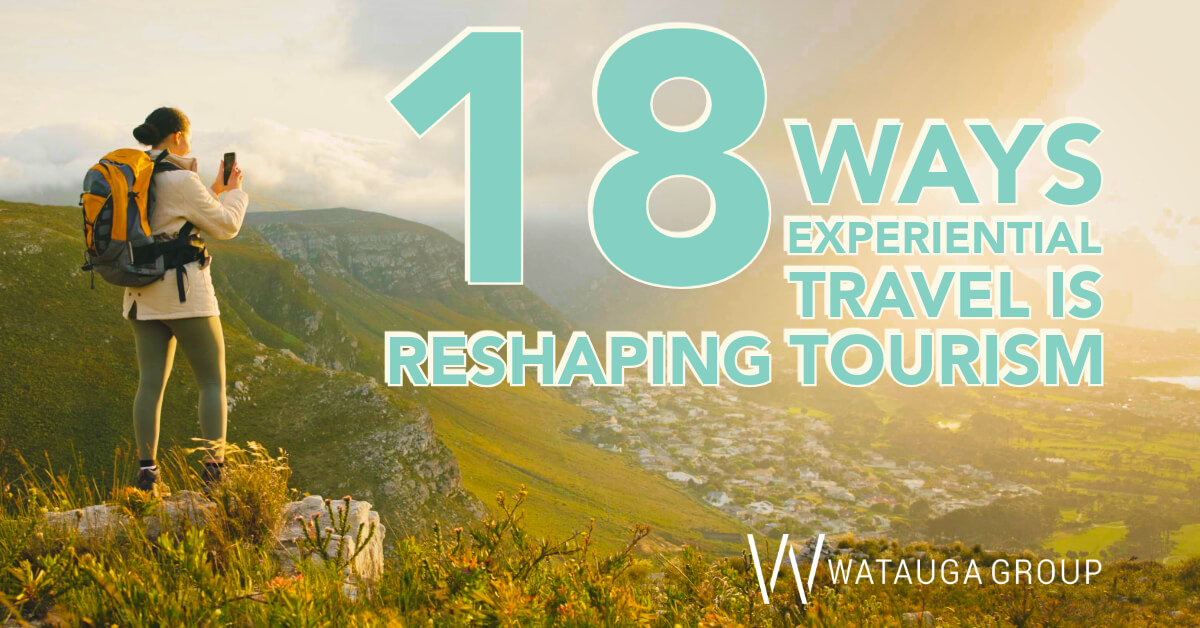
It used to be that travelers would choose a destination and then decide what to do there. Now, they choose the type of experience first, and then find the destination that offers it. This inversion of the old rules is known as experiential travel, or experience-driven travel.
Here at Watauga Group, we have studied how this phenomenon is reshaping the tourism industry at large, and how travel marketing now has to work at every level, from product development to channel strategy to messaging. In particular, we covered the psychological and behavioral foundations of experience-driven consumers in depth in our brief, Winning the Experience-Driven Consumer, which you can find here.

This strategic brief breaks down the decision-making process and demographic patterns that travel and outdoor brand marketers need to know about. We identified 18 distinct types of experiential travel, each tied to a specific consumer behavior.
These 18 types fall into four thematic clusters. In this first part of a five-part series on experiential travel, we look at those 18 clusters and types, while the companion articles go in-depth on what they mean for travel and outdoor marketing today.

Cluster One: Passion and Identity-Driven Travel
- Passion and Event-Driven Travel involves trips built around a single must-attend experience. Concerts, sporting events, film premieres, and other singular events fall under this type.Examples include the Taylor Swift Eras Tour and the Paris Olympics. These events generate massive travel, as American Express reports that 60% of global travelers planned to book at least one event-driven trip in 2025.
- Faith-Based and Pilgrimage Travel is one of the fastest-growing and most under-marketed categories in mainstream travel.The global religious tourism market was valued at $286.6 billion in 2024 and is projected to reach $671.9 billion by 2030, with the Camino de Santiago logging a record 499,242 pilgrims in 2024.
- Roots and Genealogy Travel is ancestry tourism driven in large part by the commercial DNA testing market, which has generated millions of travelers who now know exactly where their families originated.
- Set-Jetting involves fans visiting real-world locations featured in movies and television shows. A 2024 Expedia survey found that 53% of travelers have researched or booked a trip after seeing a destination on screen.
- BookTok and Literary Travel are driven by the BookTok community on TikTok, which has accumulated hundreds of billions of views. This ties in nicely with the profile of heavy readers, a group that has always enjoyed visiting places tied to books or authors they love.

Cluster Two: Nature and Environment-Driven Travel
- Adventure and Outdoor Travel focuses on challenge-driven experiences built around specific environments or feats. Instead of booking adventure generically, these travelers target a specific summit, river, or ecosystem. This type also includes travelers whose primary motivation is the opportunity to connect with nature.
- Noctourism refers to travel experiences that take place after sunset. It was named Booking.com’s top travel trend for 2025.Surveys show that two in three global travelers have considered darker-sky destinations for stargazing, once-in-a-lifetime cosmic events, or constellation tracking.
- Natural Phenomenon Travel involves trips designed specifically to witness rare or spectacular natural events.The 2024 Total Solar Eclipse generated roughly 12 million travelers moving into the path of totality across 15 states, making it the largest single mass travel event in the US in 2024.
- Coolcations appeal to travelers who want to get away from popular warm destinations during peak heat months and go to cooler locations instead. About 36% of American travelers surveyed in late 2024 found this travel type appealing.
- Purpose-Driven and Conservation Travel appeals to those interested in wildlife conservation, habitat restoration, cultural preservation, and community development.

Cluster Three: Inner Journey Travel
- Wellness Travel is all about physical restoration. Mental health retreats, digital detox, and sleep tourism are all popular destinations in this category. Some notable examples include forest bathing in Japan, hot springs in Iceland, and longevity clinics in Switzerland.Booking.com identified longevity retreats as one of the top travel trends for 2025, with 60% of surveyed travelers expressing interest.
- Slowcations is the practice of immersing yourself in fewer places rather than racing through a checklist of destinations. This was the most popular emerging trend tested in a late 2024 Future Partners survey, with 57% of American travelers finding it appealing.
- Skillcations are travel experiences specifically taken to learn or improve a skill.Cooking schools in Tuscany, surf camps in Portugal, and pottery immersions in Japan are perfect examples. The traveler comes home with a tangible new ability.
- Workcations and Bleisure Travel stem from remote work, leading to extended stays that blend professional productivity with destination exploration.
- Cultural Immersion Travel is about integrating with a destination’s local life through cooking classes, craft workshops, festivals, and homestays. Food and cuisine consistently rank as the top driver for this type of travel.

Cluster Four: Meaning and Memory Travel
- Dark Tourism is defined as travel to locations associated with death or human suffering. These include battlefields, genocide memorials, disaster sites, and former prisons.Currently, 82% of Americans have visited at least one dark tourism site, with Gen Z leading at 91% participation.
- Doom Tourism is the act of visiting endangered places before they disappear. There’s a heavy emphasis on disappearing sites, such as coral reefs, Arctic ecosystems, and sinking island nations.Research conducted in late 2024 found that around 26% of American travelers find doom tourism appealing.
- Educational and Heritage Travel incorporates structured learning about history, science, indigenous traditions, or human achievement.Institutions like Road Scholar and National Geographic Expeditions lead the way in this type of experiential travel.
The Experience is the Destination
These 18 types are all very different, but there is a throughline: the experience is now the destination. A brand that markets itself as a place rather than an experience is speaking the wrong language to today’s travel market.
Destinations that ignore this shift risk losing booking volume to competitors who understand the new traveler motivation. We built a free Brand Grader that scores your website and marketing content against the factors that matter most to experience-driven consumers. It takes about five minutes and gives you a specific benchmark plus recommendations. You can access it here.
Source List
Future Partners, State of the American Traveler, 2024